


Table of contents
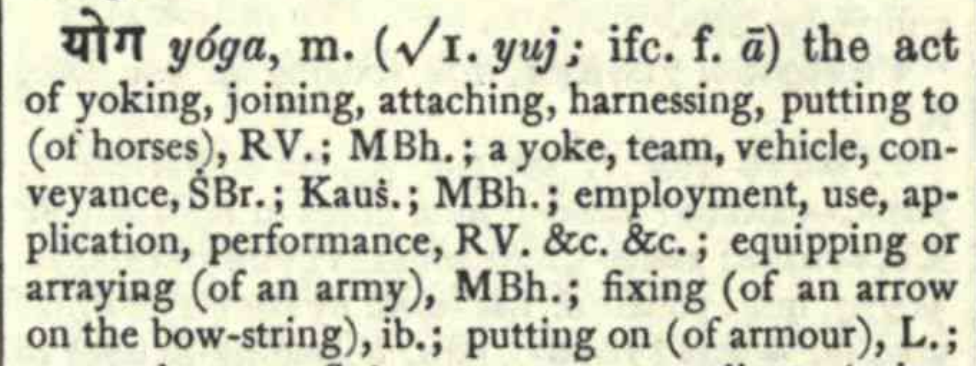
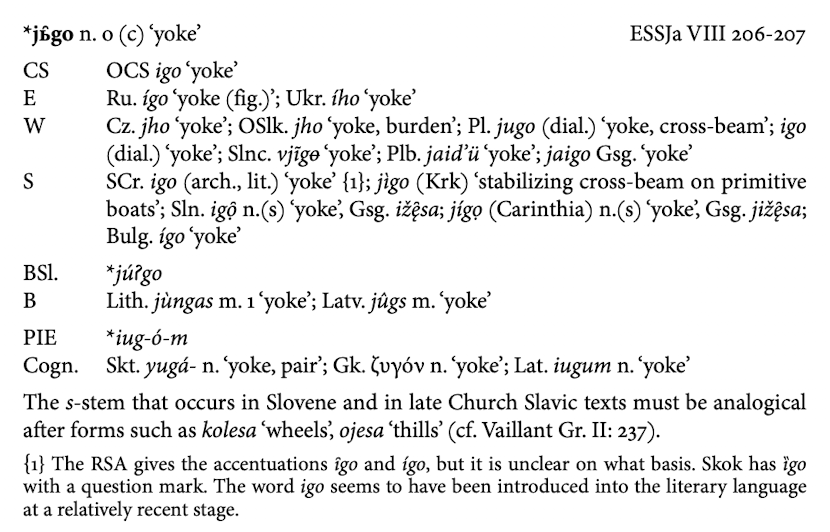
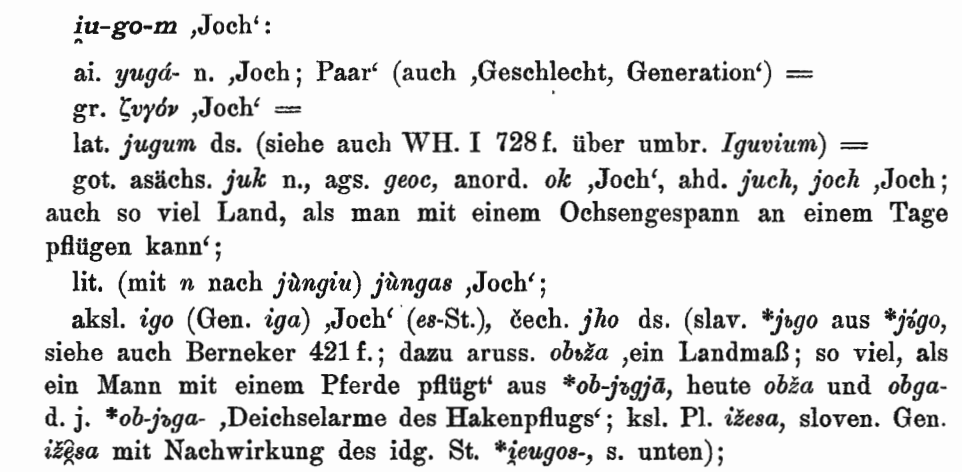
The Sanskrit word yoga (योग) means yoking (Monier-Williams, 1899, p. 856). The same root is shared by modern English ‘yoke’ from Old English geoc (Pokorny, 1959, p. 508), as well as dialectal Polish igo and Ukrainian іго (iho) ‘yoke’ (Derksen, 2008, p. 209). A word derived from this root does not appear in the Lemko dictionaries of Horoszczak (2004) or Duć-Fajfer (2025). A Greek cognate appears in the New Testament (Matthew 11:30) in the verse “for my yoke is easy and my burden is light”.
Attestations
अथ योगानुशासनम्
atha yogānuśāsanam ‘Now begins the teaching of yoga.’
(Patañjali, Yoga Sūtra 1.1)
ὁ γὰρ ζυγός μου χρηστὸς καὶ τὸ φορτίον μου ἐλαφρόν ἐστιν
For my yoke is easy, and my burden is light.
(King James Version, Matthew 11:30)
References
Bibliography
Monier-Williams, M. 1899. A Sanskrit-English Dictionary. Oxford: Clarendon Press.
Derksen, R. 2008. Etymological Dictionary of the Slavic Inherited Lexicon. Leiden: Brill.
Duć-Fajfer, O., ed. 2019–2025. Kontekstualnyj slovnyk lemkivskoho jazyka. Kraków: Wydawnictwo Księgarnia Akademicka.
Horoszczak, J. 2004. Słownik łemkowsko-polski, polsko-łemkowski. Warszawa: RuthenicArt.
King James Version, Matthew 11:30.

Leave a Reply