



Please find below the translation, etymology, full declension tables, and references for the Lemko demonstrative pronouns тот ⟨tot⟩ meaning “this” or “these”, and тамтот ⟨tamtot⟩ meaning “that” or “those”.
Table of contents
Translation
The Lemko demonstrative pronoun of dictionary (masculine singular) form тот ⟨tot⟩ is translatable into English as “this” in the singular and “these” in the plural. When prefixed with там ⟨tam⟩, (for example, тамтот ⟨tamtot⟩), it is translatable as “that” in the singular and “those” in the plural.
Etymology
The Lemko demonstrative pronoun of dictionary (masculine singular) form тот ⟨tot⟩ derives from reconstructed proto-Slavic *tŭ. Further afield, it is related to the English word that and Sanskrit तत् ⟨tat⟩ (Vasmer, 1958, p. 128), translatable as “this” and appearing in the famous line तत्त्वमसि ⟨tat tvam asi⟩ meaning “That thou art”.
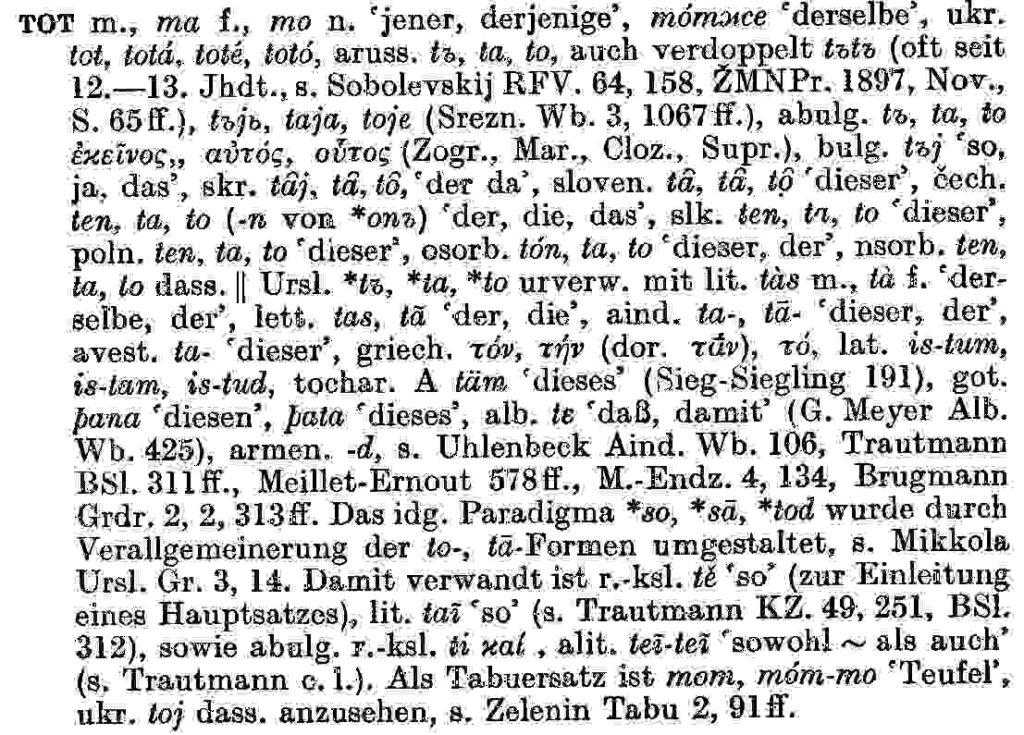
tot⟩ in Vasmer’s Russisches Etymologisches Wörterbuch, Dritter Band: Sta–Ÿ (1958, p. 128). Nearby (“this” and “these”)
Singular (“This”)
All of the following forms are translatable into English as “this”.
Masculine
| Case | Lemko | Polish | Ukrainian | Russian |
|---|---|---|---|---|
| Nominative | тот ⟨tot⟩a | ten | цей | э́тот |
| Genitive | то́го ⟨tóho⟩ | tego | цього́ | э́того |
| Dative | то́му ⟨tómu⟩ | temu | цьому́ | э́тому |
| Accusative (inanimate) | тот ⟨tot⟩a | ten | цей | э́тот |
| Accusative (animate) | то́го ⟨tóho⟩ | tego | цього́ | э́того |
| Instrumental | тым ⟨tŷm⟩b | tym | цим | э́тим |
| Locative | тым ⟨tŷm⟩c | tym | цьо́му, цім | э́том |
a Pyrtej (2013) gives той ⟨toj⟩ as an alternative form of the Lemko masculine nominative (as well as accusative inanimate) singular demonstrative pronoun (p. 107). That form is absent in Fontański & Chomiak (2000, p. 97).
b Pyrtej (2013) gives тим ⟨tym⟩ as the Lemko form of the masculine instrumental singular demonstrative pronoun (p. 107), in contrast to the form тым ⟨tŷm⟩ appearing in Fontański & Chomiak (2000, p. 97).
c Pyrtej (2013) gives тім ⟨tim⟩ as the Lemko form of the masculine locative singular demonstrative pronoun (p. 107), in contrast to the form тым ⟨tŷm⟩ appearing in Fontański & Chomiak (2000, p. 97).
Feminine
| Case | Lemko | Polish | Ukrainian | Russian |
|---|---|---|---|---|
| Nominative | то́та ⟨tóta⟩a | ta | ця | э́та |
| Genitive | той ⟨toj⟩ | tej | ціє́ї | э́той |
| Dative | тій ⟨tij⟩ | tej | цій | э́той |
| Accusative | то́ту ⟨tótu⟩b | tę | цю | э́ту |
| Instrumental | том ⟨tom⟩ | tą | ціє́ю | э́той, э́тою |
| Locative | тій ⟨tij⟩ | tej | цій | э́той |
a Pyrtej (2013) gives та ⟨ta⟩ and та́я ⟨tája⟩ as alternative forms of the Lemko feminine nominative singular demonstrative pronoun (p. 107). Those forms are absent in Fontański & Chomiak (2000, p. 97).
b Pyrtej (2013) gives ту ⟨tu⟩ and ту́ю ⟨túju⟩ as alternative forms of the Lemko feminine accusative singular demonstrative pronoun (p. 107). Those forms are absent in Fontański & Chomiak (2000, p. 97).
Neuter
| Case | Lemko | Polish | Ukrainian | Russian |
|---|---|---|---|---|
| Nominative | то́то ⟨tóto⟩a | to | це | э́то |
| Genitive | то́го ⟨tóho⟩ | tego | цього́ | э́того |
| Dative | то́му ⟨tómu⟩ | temu | цьому́ | э́тому |
| Accusative | то́то ⟨tóto⟩ | to | цей | э́то |
| Instrumental | тым ⟨tŷm⟩b | tym | цим | э́тим |
| Locative | тым ⟨tŷm⟩c | tym | цьо́му, цім | э́том |
a Pyrtej (2013) gives то ⟨to⟩ and то́є ⟨tóje⟩ as alternative forms of the Lemko neuter nominative singular demonstrative pronoun (p. 107). Those forms are absent in Fontański & Chomiak (2000, p. 97).
b Pyrtej (2013) gives тим ⟨tym⟩ as the Lemko form of the neuter instrumental singular demonstrative pronoun (p. 107), in contrast to the form тым ⟨tŷm⟩ appearing in Fontański & Chomiak (2000, p. 97).
c Pyrtej (2013) gives тім ⟨tim⟩ as the Lemko form of the neuter locative singular demonstrative pronoun (p. 107), in contrast to the form тым ⟨tŷm⟩ appearing in Fontański & Chomiak (2000, p. 97).
- References
- Fontański & Chomiak (2000, p. 97).
- Pyrtej (2013, p. 107).
Plural (“These”)
The following forms are used regardless of grammatical gender and are translatable into English as “these”.
| Case | Lemko | Polish | Ukrainian | Russian |
|---|---|---|---|---|
| Nominative | то́ты ⟨tótŷ⟩ | te/ci | ці | э́ти |
| Genitive | тых ⟨tŷch⟩ | tych | цих | э́тих |
| Dative | тым ⟨tŷm⟩ | tym | цим | э́тим |
| Accusative (inanimate) | то́ты ⟨tótŷ⟩ | te | ці | э́ти |
| Accusative (animate) | тых ⟨tŷch⟩ | tych | цих | э́тих |
| Instrumental | ты́ма ⟨tŷma⟩ | tymi | ци́ми | э́тими |
| Locative | тых ⟨tŷch⟩ | tych | цих | э́тих |
Distant (“that”, “those”)
To communicate distance from the speaker, simply prefix all of the above pronouns with Lemko там ⟨tam⟩. This is equivalent to saying “that” instead of “this” or “those” instead of “these” in English.
Singular (“That”)
| Case | Masculine | Feminine | Neuter |
|---|---|---|---|
| Nominative | тамтот ⟨tamtot⟩a | тамто́та ⟨tamtóta⟩d | тамто́то ⟨tamtóto⟩x |
| Genitive | тамто́го ⟨tamtóho⟩ | тамтой ⟨tamtoj⟩ | тамто́го ⟨tamtóho⟩ |
| Dative | тамто́му ⟨tamtómu⟩ | тамтій ⟨tamtij⟩ | тамто́му ⟨tamtómu⟩ |
| Accusative (inanimate) | тамтот ⟨tamtot⟩a | тамто́ту ⟨tamtótu⟩e | тамто́то ⟨tamtóto⟩ |
| Accusative (animate) | тамто́го ⟨tamtóho⟩ | тамто́ту ⟨tamtótu⟩e | тамто́то ⟨tamtóto⟩ |
| Instrumental | тамтым ⟨tamtŷm⟩b | тамтом ⟨tamtom⟩ | тамтым ⟨tamtŷm⟩b |
| Locative | тамтым ⟨tŷm⟩c | тамтій ⟨tamtij⟩ | тамтым ⟨tamtŷm⟩c |
a Pyrtej (2013) gives той ⟨toj⟩ as an alternative form of the Lemko masculine nominative (as well as accusative inanimate) singular demonstrative pronoun (p. 107). That form is absent in Fontański & Chomiak (2000, p. 97).
b Pyrtej (2013) gives тим ⟨tym⟩ as the Lemko form of the masculine and neuter instrumental singular demonstrative pronoun (p. 107), in contrast to the form тым ⟨tŷm⟩ appearing in Fontański & Chomiak (2000, p. 97).
c Pyrtej (2013) gives тім ⟨tim⟩ as the Lemko form of the masculine and neuter locative singular demonstrative pronoun (p. 107), in contrast to the form тым ⟨tŷm⟩ appearing in Fontański & Chomiak (2000, p. 97).
d Pyrtej (2013) gives та ⟨ta⟩ and та́я ⟨tája⟩ as alternative forms of the Lemko feminine nominative singular demonstrative pronoun (p. 107). Those forms are absent in Fontański & Chomiak (2000, p. 97).
e Pyrtej (2013) gives ту ⟨tu⟩ and ту́ю ⟨túju⟩ as alternative forms of the Lemko feminine accusative singular demonstrative pronoun (p. 107). Those forms are absent in Fontański & Chomiak (2000, p. 97).
f Pyrtej (2013) gives то ⟨to⟩ and то́є ⟨tóje⟩ as alternative forms of the Lemko neuter nominative singular demonstrative pronoun (p. 107). Those forms are absent in Fontański & Chomiak (2000, p. 97).
Plural (“Those”)
| Case | Lemko | Polish | Ukrainian | Russian |
|---|---|---|---|---|
| Nominative | тамто́ты ⟨tamtótŷ⟩ | tamte/tamci | ті | те |
| Genitive | тамтых ⟨tamtŷch⟩ | tamtych | тих | тех |
| Dative | тамтым ⟨tamtŷm⟩ | tamtym | тим | тем |
| Accusative (inanimate) | тамто́ты ⟨tamtótŷ⟩ | tamte | ті | те |
| Accusative (animate) | тамтых ⟨tamtŷch⟩ | tamtych | тих | тех |
| Instrumental | тамты́ма ⟨tamtŷma⟩ | tamtymi | ти́ми | те́ми |
| Locative | тых ⟨tamtŷch⟩ | tamtych | тих | тех |
References
1. ^ Fontański, H., Chomiak, M. (2000). Ґраматыка лемківского языка [Grammar of the Lemko Language]. Śląsk.
2. ^ Pyrtej, P. (2013). Лемківські говірки. Фонетика і морфологія. Об’єднання лемків [Lemko Dialects. Phonetics and Morphology].
3. Vasmer, M. (1958). Russisches Etymologisches Wörterbuch, Dritter Band: Sta–Ÿ [Russian Etymological Dictionary, Volume Three: Sta–Ÿ]. Carl Winter Universitätsverlag.

Leave a Reply